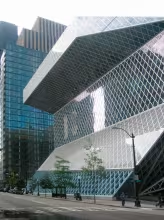
There is little to say about such a glass façade. A steel-profiles mesh covers everyday life like a blanket.

There is little to say about such a glass façade. A steel-profiles mesh covers everyday life like a blanket.
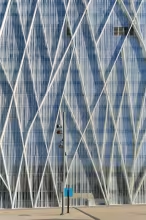
Load bearing facades are nowadays a common solution due to the permeability they permit in the inner space. Some of those structures are let to be seen from the outside, some of them are not.
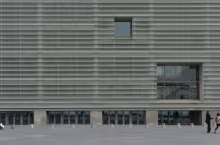
This is another classic that should not be missed. It is unquestionably impeccable. Let us simply highlight the potential of resorting to a simple curtain wall with a few crucial variations: the exceptional glass with its curvature, texture and roughness; its format and size; and the lack of collinearity between mullions and transoms, enhancing horizontality. All of these factors contribute to accompanying the gesture of both volumes towards the sea. The position of the two blocks, the volumetry and the façade definition all talk the same language.
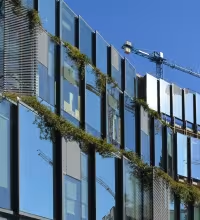
It is surprising how this facade makes a virtue of the sometimes uncomfortable transparency of the glass.
The succession of staggered and slightly overlapped planes that, either reflect the neighboring facades, or exhibit the daily life of the interior space, combined with opaque surfaces placed in different planes and rolling interior sunscreens, manages to create an abstract order that gives coherence to the whole.
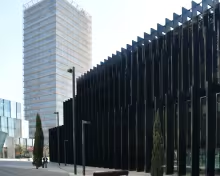
Awarded the Pritzker in architecture, the value of this work is undeniable from a formal perspective. However, doubts arise when we consider the functional aspects of thermal and lighting comfort in a Mediterranean climate at 41 degrees latitude.
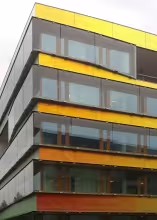
In this building by Stump & Schibli Architekten we want to highlight the wisdom of solving the blind area with continuous horizontal stripes along the façades, while the treatment of the openings is adapted to varying conditions in the courtyard façades and the more urban ones.
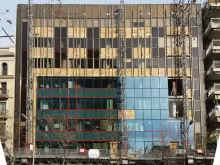
Here we see a very interesting process of replacing a stick curtain wall with another, whilst keeping the building in use and without a provisional enclosure a few metres from the façade.